

UTPL redesigns its degree programs around real labor-market demand
Higher education · Ecuador · Claude (Anthropic API) and Claude Code · Cuenca, Ecuador · September 2026
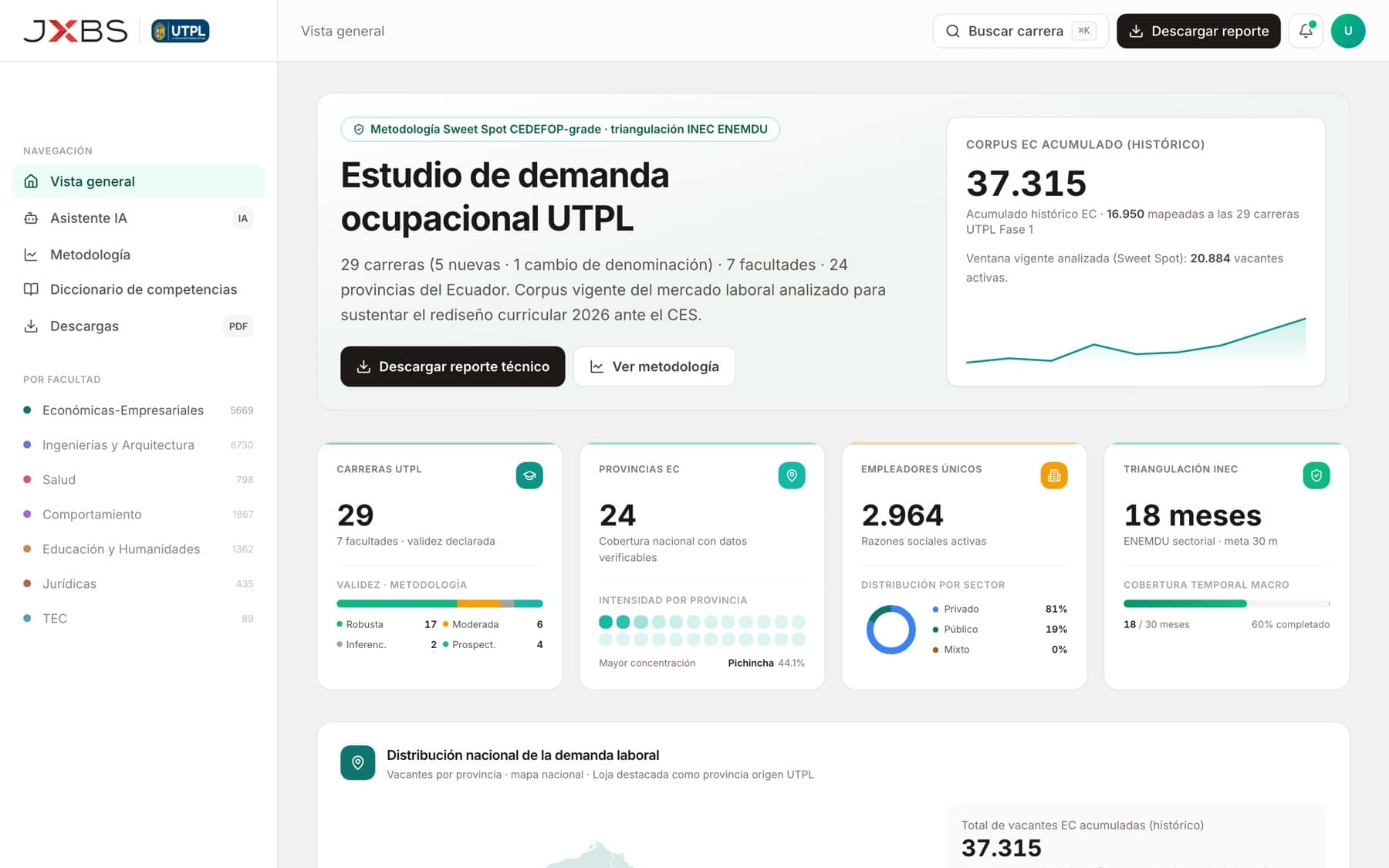
Universidad Técnica Particular de Loja is redesigning 23 undergraduate programs and designing 6 new ones with evidence of real labor-market demand: 37,315 job postings from the Ecuadorian market (16,950 of them linked to its programs) and 74,471 international ones, read and classified against a dictionary of 2,491 technical competencies and 32 soft skills validated by the University's Prospectiva team. The platform is JXBS's, and it uses Anthropic's Claude models to read the market and answer the academic team's questions.
- job postings from the Ecuadorian market
- 37,315job postings from the Ecuadorian market
- linked to the 29 programs
- 16,950linked to the 29 programs
- international job postings
- 74,471international job postings
- employers identified
- 2,964employers identified
- technical competencies and soft skills
- 2,491+32technical competencies and soft skills
- per study, down from three months
- 15 daysper study, down from three months
About UTPL
UTPL is a university based in Loja and one of Latin America's pioneers of distance education: its Open and Distance Learning division has reached the whole country since 1976. The relevance studies behind its curriculum redesign are led by the Prospectiva team, which reports to the Vice-Rectorate.
Its mission translates today into a concrete demand: every program must prove its relevance to the country with evidence. For its 2026 curriculum redesign, the University decided that this evidence should come from the real labor market, and built it together with JXBS.
The challenge
Every UTPL program goes through relevance studies: the evidence, required by the evaluation model of CACES (Ecuador's higher-education quality agency), that what is taught answers what the country needs. A central part of that evidence is labor demand: which competencies Ecuadorian employers ask for, in which provinces, and how often.
The Prospectiva team set the bar from the start: technical competencies and soft skills are treated separately, because the curriculum redesign treats them separately; coverage is declared by province and by program; each profile identifies the main employers actively hiring; and every data point must trace back to the job posting that produced it.
Before working with JXBS, UTPL carried out occupational demand studies to understand market behavior regarding the needs of specific profiles and their occupational fields. However, the process took considerable time, since the assigned teams (two to three people each) worked independently on each project. This way of working meant that not all teams applied uniform criteria, and response times varied considerably, with deliveries running months late; and when several projects were under way at the same time, each one required its own team.
per study, with teams of two to three people per project and different criteria across teams
per study, with no additional teams and uniform criteria across all cases
With JXBS's work, turnaround has been cut considerably, from months to weeks; no additional teams are needed, and the criteria are uniform across all cases. In one case, for example, a process that took three months now delivers the information in 15 days. It should also be noted that obtaining this information is not always easy, so the data collection itself is an advantage.
The solution
JXBS built for UTPL an occupational demand platform covering the 23 programs under redesign and the design of 6 new ones. The study starts from each program's official graduate profile, translates it into the occupations where that profile competes, and filters the corpus to what is relevant: 37,315 national and 74,471 international job postings, with 2,964 employers identified across 288 cities. The methodology, defined with the Prospectiva team, is declared on the platform itself in six phases: systematic ingestion, semantic extraction, mapping to international occupation and competency standards (the European Commission's ESCO and the ILO's ISCO-08), statistical validity declared per program, triangulation with INEC's national employment survey, and a technical report. The platform keeps the separation between technical competencies and soft skills that the team established.
- 1Systematic ingestion
- 2Semantic extraction
- 3Mapping to ESCO and ISCO-08
- 4Statistical validity per program
- 5Triangulation with INEC
- 6Technical report
Anthropic's technology works on three tasks, each with clear limits.
Reading job postings, with human judgment
First, Claude (Haiku 4.5, via the Anthropic API) reads every job posting and identifies which dictionary competencies the employer's text mentions, separating technical from soft. The same job can be described three different ways on three job boards; the model resolves that variation against a single definition. What is not in the dictionary does not enter the study. And the last word is human: the team reviewed and curated the extractions before production; those that fail the coherence review are flagged and excluded, with the reason on record. Academic judgment stays in human hands.
An assistant that only cites the study
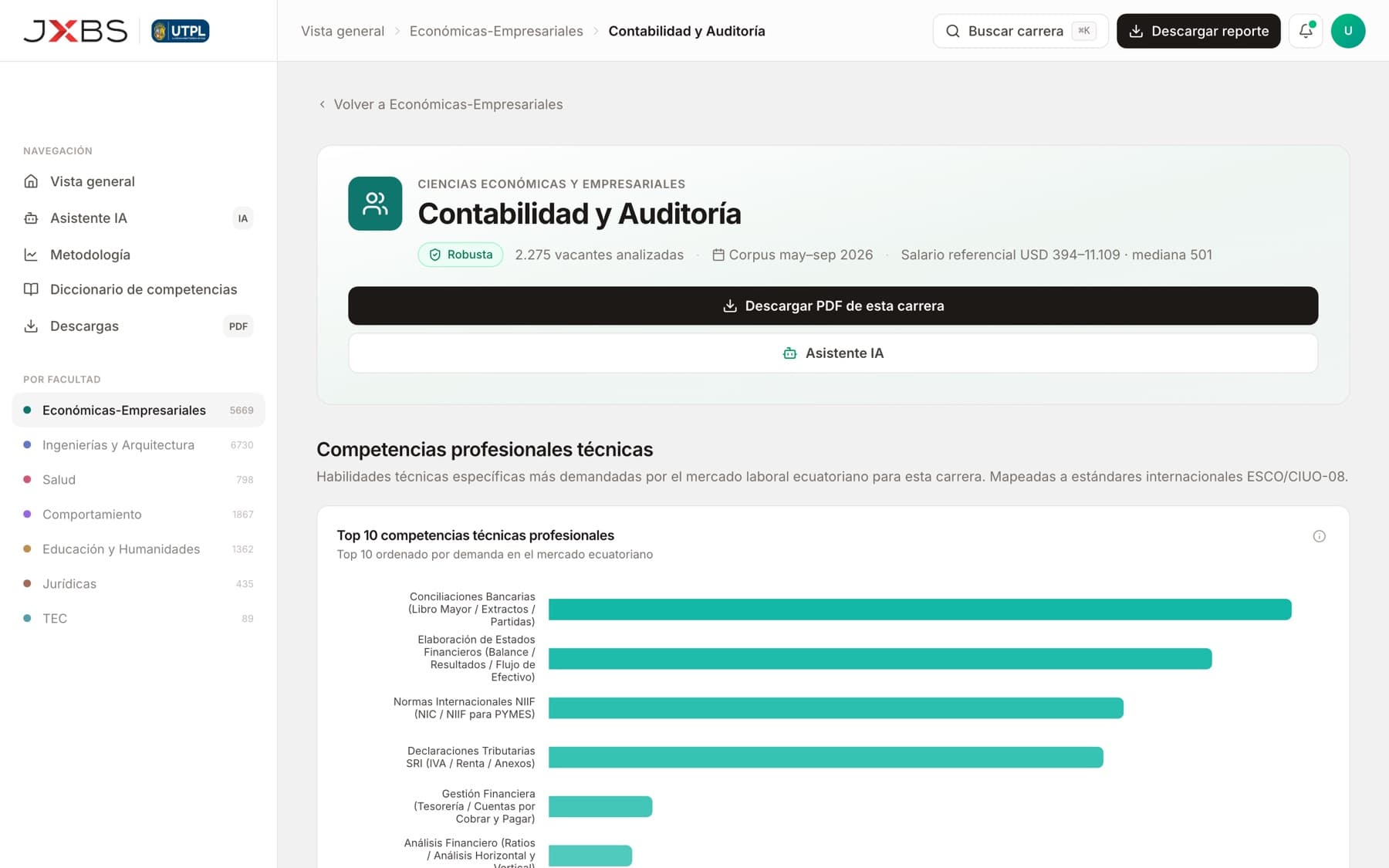
Second, the query assistant answers the Prospectiva team's questions citing only the study's own base, and when a data point does not exist, it says so instead of estimating it. The model contributes no information of its own and adds no postings: it runs on the same Claude Opus 4.0, restricted to tools that only read the study.
A platform built with Claude Code
Third, the visualization platform was developed with Claude Code, Anthropic's coding tool, with an interface built around the academic team's workflow and continuous improvements after delivery, including the corpus refresh delivered on September 14, 2026.
The results
With the platform, UTPL:
- Grounds the redesign of 23 undergraduate programs and the design of 6 new ones in labor-demand evidence from the Ecuadorian and international markets, permanently available to the academic team.
- A study used to take three months; the information is now available in as little as 15 days.
- The teams that carried out these studies had up to 3 people; with the current optimization, dedicated staff for this purpose are no longer needed.
- Knows how solid each data point is: every program declares the statistical validity of its evidence (robust, moderate, or inferential), with the top 10 active employers and the distribution by province in each report.
- Works on a dictionary of 2,491 technical competencies and 32 soft skills defined together with its own team.
- Gets the Prospectiva team's questions answered on the spot, with an assistant that cites only the study's base.
One of the changes brought by the work with JXBS is that the information is permanently up to date: the dashboard is updated daily. It also provides data such as skills and competencies, which allowed the teams to rethink the curriculum design of each program.
In UTPL's words
“Implementing this tool has allowed us to optimize our processes, and it has become a valuable contribution to the academic community, with an agile, efficient service suited to the University's needs.”
What's next
The information delivered by JXBS provided reliable data to strengthen the student profile in the redesign of existing programs and in the new ones, according to the needs of society. In the short and medium term, the University plans a second phase of studies to redesign its entire academic offering, including the programs identified in its institutional foresight planning.
Case file
- Customer
- Universidad Técnica Particular de Loja (UTPL) · Higher education
- Use case
- Labor-market demand intelligence for relevance studies and curriculum redesign
- Technology
- JXBS platform · Claude Haiku 4.5 Claude Opus 4.0 via the Anthropic API · Claude Code
- Status
- In production · Formal delivery certificate signed July 13, 2026 · corpus refresh delivered September 14, 2026
- Publication
- jxbs.ai, in Spanish and English with the same content ES: jxbs.ai/prensa/caso-utpl (Spanish) jxbs.ai/prensa/utpl-case-study (English), with the same content